Jenna works twelve-hour nursing shifts, and she shares her two-bedroom apartment with Biscuit, a golden retriever with a world-class shedding program. She would come home exhausted to tumbleweeds of golden hair rolling across the hardwood, drifting under the couch, and woven into the area rug. Vacuuming after every shift was not happening. Guests started declining to sit on the floor.
A robot vacuum will not replace your full-size vacuum. But for pet owners, the right one changes the baseline: instead of hair accumulating for a week, it gets collected daily while you are at work. The trick is buying for pet hair specifically, because a robot that is fine for dust can choke on a husky's undercoat.
What Actually Matters for Pet Hair
Brush roll design. This is the big one. Traditional bristle brushes wrap hair into a tangled mess that needs cutting out weekly. Rubber or silicone fin-style rollers shed hair into the bin instead of winding it up. If you have a heavy shedder, this single feature matters more than anything else on the spec sheet.
Suction and agitation. Hair on hard floors is easy; hair embedded in carpet or rugs is the real test. Look for strong suction plus a brush system that agitates carpet fibers. If your home is mostly rugs, prioritize this over fancy navigation.
Bin size or self-emptying. Pet hair fills small bins fast. A robot with a tiny bin will clean for twenty minutes, fill up, and quit. For heavy shedders, a self-emptying base that holds weeks of debris is worth the premium; for light shedders, a larger onboard bin suffices.
Filtration. A sealed HEPA-style filter traps dander and fine dust instead of blowing it back into the room. It matters for allergies and for that faint dog smell that lingers.
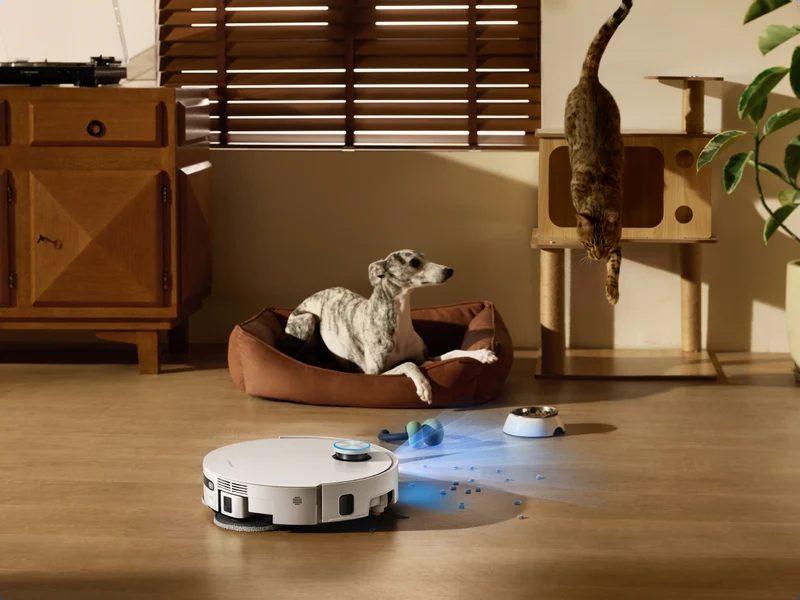
Obstacle avoidance. Pet homes have toys, chews, bowls, and the occasional accident. Decent obstacle detection steers around objects instead of plowing through them or getting stuck under the recliner.
Match the Robot to Your Floors
Mostly hard floors with a few rugs? Nearly any decent robot handles this, and you can prioritize quiet operation and slim design. Wall-to-wall carpet or thick area rugs? Prioritize suction, brush agitation, and battery life, because carpet cleaning drains batteries faster. Mixed homes do best with a robot that auto-adjusts suction when it detects carpet.
Getting the Most From Your First Week
Run the robot while you are home the first few times so you can rescue it from trouble spots: the fringe on that one rug, the gap under the media console, the dog's favorite chew toy. Clear those hazards or set no-go zones, and after that let the schedule handle it. Empty the bin or check the base after the first three runs; that tells you how fast your pets fill it and whether you need daily or every-other-day scheduling. Most owners find a rhythm within a week and never think about it again.
Common Mistakes to Avoid
The classic mistake is expecting the robot to replace deep cleaning entirely. It maintains; it does not extract embedded hair from a shag rug like a full-size vacuum. The second is skipping no-go zones: set them around water bowls, pet beds, and feeding areas on day one. The third is buying a tiny-bin model for a heavy shedder and wondering why it quits mid-cycle. And pick up cords, socks, and small toys before it runs, at least until you learn what your model eats.
Frequently Asked Questions
Can a robot vacuum fully replace my regular vacuum? No. Think of it as daily maintenance that keeps hair from accumulating, with a full-size vacuum handling deep cleaning every week or two. Together they are unbeatable.
Will it fall down the stairs? Modern robots have cliff sensors that detect drops and turn around. They are reliable on standard staircases, but keep the sensors clean for them to work.
How often should I run it with pets? Daily is the sweet spot for moderate to heavy shedders. Scheduling it while you are out means you come home to clean floors without hearing it.
What about homes with multiple pets? Prioritize a self-emptying base and tangle-resistant brushes. Two heavy shedders will overwhelm a small-bin robot in a single run.
Jenna runs hers every weekday at noon. She still does a proper vacuum on Sundays, but the tumbleweeds are gone, the rug looks like a rug again, and guests sit on the floor without a second thought. The robot did not eliminate pet hair. It just stopped letting it win.
Our Top Picks
PetGlide X7 Self-Empty Robot Vacuum
A self-emptying robot with a tangle-resistant brush roll built for heavy shedders. The base holds weeks of hair so you rarely touch the bin.
- Self-empty base means weeks between manual emptying
- Rubber brush roll resists hair wrap far better than bristles
- The base station is bulky and needs a dedicated corner
VacPro Slim Pet Robot
A low-profile robot with strong suction that slips under sofas and beds where pet hair gathers in drifts.
- Slim body reaches the dust zones other robots miss
- Strong pickup on both hard floors and low-pile rugs
- Smaller onboard bin needs emptying every day or two with heavy shedders
HomeSweep LiDAR Navigation Robot
A laser-mapped robot that cleans in neat rows and lets you set no-go zones around pet bowls and beds.
- Methodical navigation covers every inch without random bumping
- App no-go zones protect water bowls and pet beds
- Initial mapping and app setup take patience
DustFree Mini Robot for Apartments
A compact, quiet, budget-friendly robot that keeps hard floors and area rugs presentable between deep cleans.
- Gentle on the budget and quiet enough to run while you work
- Compact size navigates tight apartment layouts
- Random navigation can miss spots in larger or complex rooms
MopMate 2-in-1 Vacuum and Mop Robot
A mid-priced robot that vacuums pet hair and mops hard floors in one run. Good for homes that are mostly hard flooring with some rugs.
- Vacuums and mops in a single pass
- Decent water tank for its size
- Mopping is light; won't replace a real mop
TangleFree Anti-Wrap Brush Robot
A premium robot with a brush designed to resist hair wrap. Pet owners spend far less time cutting hair off the roller.
- Brush needs de-hairing far less often
- Strong suction on carpets
- Premium price for the brush system
BaseCamp Self-Empty Dock Bundle
A premium bundle pairing a capable robot with a self-empty dock that holds weeks of debris. Empty the dock monthly, not the robot daily.
- Weeks between dock emptying
- Sealed bags trap allergens
- Dock is bulky; needs a permanent spot
WhisperRun Quiet Night-Clean Robot
A mid-range robot tuned for low noise, meant to run overnight or during work calls without disturbing anyone.
- Quiet enough for nighttime schedules
- Gentle around pet sleeping areas
- Lower noise means slightly lower suction
SpotBot Small-Area Pet Robot
A budget compact robot for spot-cleaning the dog's favorite rug or the litter-box zone. Small, simple, and cheap enough to be a second unit.
- Cheap enough as a second robot
- Handles high-traffic pet zones well
- No mapping; bumps around randomly