When Priya signed the lease on her 480-square-foot studio in Chicago, the first thing she bought was a sofa. She found a beautiful 94-inch three-seater on sale and clicked "buy" on her phone. On delivery day, the movers got it up three flights of stairs, turned the corner, and stopped cold. It would not fit through her 29-inch doorway — not at an angle, not with the legs off, not even with the door removed.
She refused the delivery and ate a restocking fee. Back at square one, she did what she should have done first: she grabbed a tape measure. A month later she owned a 72-inch apartment sofa that sailed through the door — and suited her studio better than the big one ever would have.
If your living room doubles as your dining room, office, and occasional guest room, this guide is for you. Here is how to buy a sofa that actually fits your apartment — and your life.
Measure the path, not just the room
Most sofa disasters happen in the hallway, not the living room. Measure the full delivery path before you shop:
- Doorways: Measure the narrowest door frame to frame, door fully open. Most apartment doors run 28 to 32 inches, and many full-size sofas are too deep to angle through.
- Hallways and turns: Measure the hallway width and the clearance at every turn. A tight 90-degree corner is the classic dealbreaker.
- Elevators and stairs: Measure the elevator door and interior diagonal. On stairs, check the narrowest point between railing and wall, plus landing ceiling height.
- The wall itself: Leave a few inches of breathing room on each side. A sofa that exactly fills a wall makes a small room feel like a corridor.
Tape the sofa's footprint on your floor and live with the outline for a day. It tells you more than any product photo.
Learn the three numbers that matter
- Overall width: Standard sofas run about 84 to 96 inches; apartment sofas about 68 to 78; loveseats about 48 to 60. That 10-inch step down is often the difference between a room that breathes and one that does not.
- Overall depth: Around 34 to 38 inches is typical, and every inch is floor space you lose.
- Seat depth: The comfort number. Around 20 to 22 inches suits most adults for relaxed sitting. Shallower seats (18 to 19 inches) keep you upright — good if you are shorter or work from the couch. Very deep seats look inviting but can leave shorter sitters with dangling feet.
If the sofa floats mid-studio, check back height too — a low back keeps sightlines open.
Pick the right type for your life
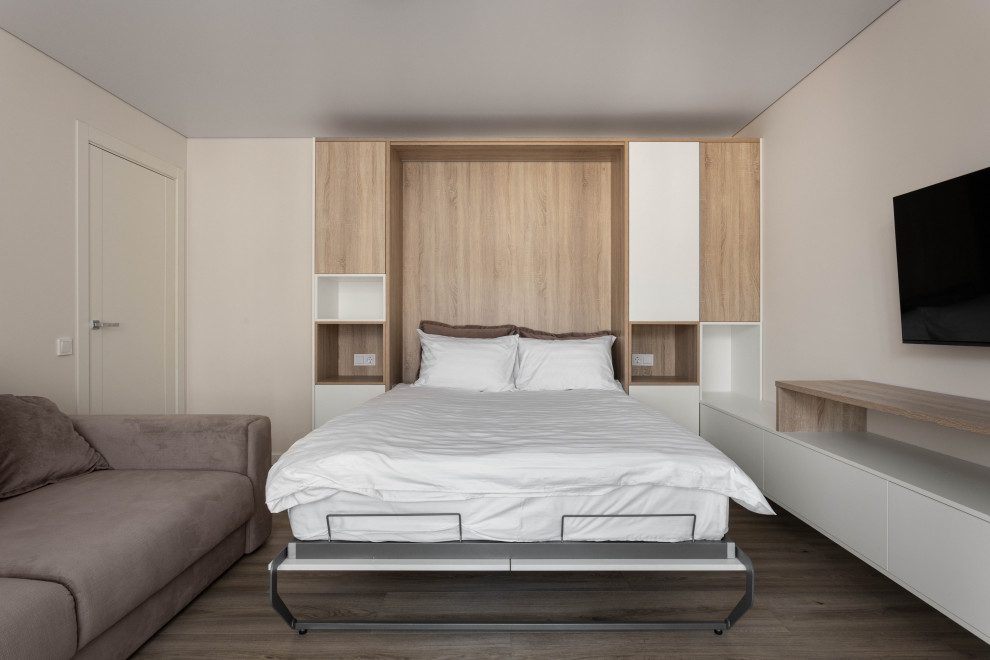
- A sleeper sofa earns its footprint if you host overnight guests even a few times a year. In a studio it can be bed and couch in one — but only if the mechanism opens easily.
- An apartment-size sofa (roughly 68 to 78 inches) seats three without standard three-seater bulk. The sweet spot for most small living rooms.
- A loveseat fits short walls or rooms shared with a desk or dining table. Comfortable for two; a squeeze for three.
- Armless and low-arm designs waste less width on arms, so more of the footprint is actual seating, and the room looks less crowded.
Buy for your real week. If you work from the couch, prioritize seat comfort over a guest bed you will open twice a year.
Avoid the mistakes everyone makes
- Buying for the room you wish you had. That sprawling sectional belongs in a future house. Buy for the apartment you live in now.
- Forgetting the delivery path. Measure before you order — refused deliveries often carry restocking fees.
- Ignoring seat depth. A sofa too deep for your frame is uncomfortable no matter how good it looks. Check the number before you commit, especially if you are on the shorter side.
- Going dark and bulky. Raised legs, low profiles, and lighter fabrics make small rooms feel bigger by showing floor and letting light move.
- Skipping the in-person try. If a floor model exists nearby, sit on it. Ten real minutes beat a hundred reviews.
Frequently Asked Questions
Can a sleeper sofa be comfortable for everyday sitting?
Yes, if you choose well. Modern designs are far better than the old bar-across-your-back models. Look for a solid seat deck and decent cushion thickness. If it is your primary seat, prioritize daytime comfort — guests forgive a lot.
Loveseat or sofa for a 10-by-12-foot living room?
Most 10-by-12 rooms handle an apartment-size sofa (around 70 inches) plus a side table. Choose the loveseat if the room also holds a desk or dining table. Tape the outline on the floor first.
How do I know it will fit through my door?
Compare the sofa's smallest dimension — usually its depth, or its height with the legs removed — against your narrowest doorway. If the doorway is at least as wide as the sofa is deep, minus a few inches, it can usually angle through. Sofas that assemble in the room remove the question entirely.
What seat depth should I look for?
Around 20 to 22 inches suits most adults for relaxed lounging. If you are under about 5-foot-4 or sit upright to work, aim for 18 to 20 inches so your feet reach the floor. Taller sitters often prefer 22 inches or more.
A good small-apartment sofa is not a compromise — it is the right tool for the space. Measure the path, match the type to your real life, and tape that outline on the floor before you buy. Priya's second sofa cost less than the first, fit through the door on the first try, and left her enough floor for the bookshelf she uses every day. That is what winning looks like in a small apartment.
Our Top Picks
Novogratz Brittany Sleeper Sofa
A budget-friendly sleeper that looks far more expensive than it is. The split-back design lets one side recline while the other stays upright, and it folds flat into a bed for guests.
- Very affordable for a sleeper
- Converts easily between sofa, lounger, and bed
- Firm seating that some will find too hard for daily lounging
IKEA FRIHETEN Sleeper Sofa
A longtime favorite for studio apartments, with a hidden storage compartment under the seat and a pull-out bed. The slipcover comes off for washing, which matters when your sofa doubles as a guest bed.
- Generous under-seat storage
- Removable washable cover
- The pull-out mechanism takes a little muscle to operate
Burrow Nomad Loveseat
A mid-range modular loveseat that ships in boxes and assembles without tools — a real advantage in walk-up buildings. Clean lines and a compact footprint suit small living rooms.
- Arrives in carryable boxes, no elevator needed
- Modular design can expand later
- Cushions sit on the firmer side and need regular fluffing
Albany Park 68 Inch Apartment Sofa
A premium apartment-size sofa with deeper, plusher seating than most compact options. The low profile and slim arms keep it from visually overwhelming a small room.
- Noticeably more comfortable than typical apartment sofas
- Slim silhouette fits tight spaces
- Higher price than larger big-box alternatives
Arden 72-Inch Studio Apartment Sofa
A mid-priced apartment sofa with a reversible chaise that can switch sides when you rearrange. The seat depth hits a comfortable middle ground for both sitting upright and curling up.
- Reversible chaise adapts to any layout
- Seat depth works for sitting and lounging
- Chaise section cannot be removed entirely
Novogratz Tallulah Memory Foam Futon
A budget futon with a memory foam core that folds flat into a guest bed. Slim arms and a low back keep it from dominating a small room.
- Very affordable for a sleeper option
- Memory foam sleeps better than spring futons
- Seat cushions slide forward with heavy daily use
Hearthline 58-Inch Convertible Loveseat
A compact loveseat whose backrest folds down into a twin-size sleeper. Ideal for studios that need to host the occasional overnight guest.
- Converts to a sleeper in seconds
- Narrow 58-inch width fits tight walls
- Two adults will find the sleeper snug