Jenna, a marketing coordinator in Austin, gets home at 6:40. Her 620-square-foot living room is her office, reading nook, and movie theater. She flips the single ceiling fixture on, and the room snaps into flat, chalky brightness — her cream sofa looks gray. She switches it off and reads by kitchen spill light, but the couch half goes cave-dark.
Jenna blames the room — maybe a bigger rug or different paint. But the furniture is fine; one light source is simply doing a job it was never meant to do alone.
The fix is more lights, smaller and smarter, working together: the three-layer approach, adapted for a real budget and a rental. One evening and about $120 to $300 will make the room feel like a different apartment.
Why one light can never be enough
A single ceiling light has two fatal flaws: it shines from above and slightly in front of everything, flattening faces and washing out texture, and it gives you exactly one mood. Morning coffee wants soft and low, remote work needs focused and bright, movie night wants dim and cozy — one switch cannot do all of that.
The three layers, in plain terms
- Ambient light is the base layer: the overall wash that keeps you from tripping over the ottoman. A ceiling fixture or a tall torchiere bouncing light off the ceiling does this job.
- Task light is focused light for a job: reading, knitting, sorting mail. A floor lamp bent over your reading chair or a small table lamp at the desk corner counts — the light should land on the work, not your eyes.
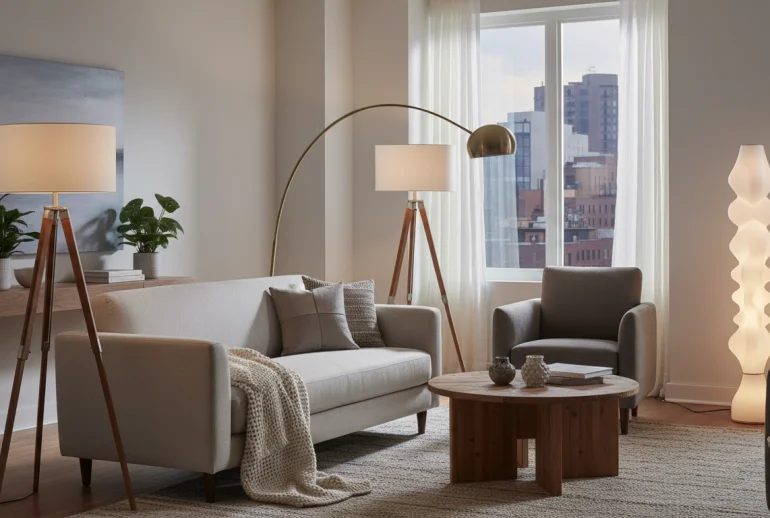
- Accent light is the fun layer. It highlights what you love: a bookcase, a gallery wall, a tall plant. Plug-in sconces, picture lights, and small uplights behind furniture create pools of brightness that give a room depth.
Aim for three to five sources across the three layers — most cost $30 to $80 each.
Placement rules that actually work
- Spread light around. Put one source in three of the room's four zones — lights clustered on one side leave the other dead.
- Vary the heights. Mix a tall floor lamp, table lamps (shade bottom 40 to 46 inches, about seated eye level), and something aimed up, like a sconce. One level feels flat.
- Put reading light behind your shoulder. Reading on the left end of the sofa? The floor lamp stands just behind your left shoulder, shade bottom near seated eye level — page bright, eyes out of the glare.
- Light the walls. Point an uplight at a light-colored wall and watch the room lift — bounced light brightens without glare.
Color temperature, translated into English
- 2700K — candlelight warm. The classic cozy bulb: wood tones glow, skin looks healthy. The right default for most living rooms.
- 3000K — warm white, slightly cleaner. A half-step up that renders colors a touch more accurately — good if your living room doubles as your workspace.
- 5000K — daylight blue. Hospital-hallway light — fine for a garage, terrible where you relax.
Keep bulbs consistent within a sightline — a 2700K table lamp next to a 5000K floor lamp looks broken. Replace them all at once, and note the Kelvin number on the box flap.
Renter-friendly upgrades that need no electrician
Every layer has a plug-in version: a tall torchiere or arc lamp bouncing light off the ceiling for ambient, a clamp lamp on a bookshelf or adjustable-arm floor lamp for task, plug-in sconces or battery picture lights for accent.
The one constraint is cord management: ten dollars of cord covers along the baseboard, each cord run straight down the wall.
Dimmers and smart bulbs
If you buy one upgrade, make it dimmability: a $15 plug-in dimmer gives any floor lamp full brightness for cleaning, half for evening, and a low glow before bed.
Smart bulbs go further, letting you change brightness and color temperature from your phone — one bulb can be your 3000K afternoon work light and your 2700K evening lamp. Start with a starter kit in your two most-used lamps; just leave the physical switch on.
Common mistakes to avoid
- Bulbs too cool. If your room feels harsh and nobody can say why, check the Kelvin rating — daylight bulbs in a living space are the most common lighting mistake.
- Everything at one height. One height change adds more depth than a fourth lamp at the same level.
- One switch, one mood. If every light shares one switch, you still have one light. Use separate switches, plug-in dimmers, or smart controls to mix ambient and accent levels.
Frequently Asked Questions
How many lights does a small living room need? Three to five: one ambient, one or two task lamps where you read or work, and one or two accent lights for walls, shelves, or art. A 10-by-12-foot room gets away with three well-placed lamps.
Can I mix warm and cool bulbs in the same room? Not within one sightline — the clash looks unintentional. Use 3000K in a work corner and 2700K in the conversation area if a wall separates them, keeping each zone consistent.
What is the cheapest way to start layering light? A plug-in dimmer and a second lamp: dim your existing lamp for the evening, add a warm bulb in a dark corner. Under $60 tests the concept.
Are LED bulbs okay for a cozy living room? Yes — pick 2700K with a high color-rendering index (CRI 90+), which renders wood, fabric, and skin tones faithfully.
Great lighting is not about expensive fixtures — it is about enough sources, at enough heights, at the right warmth, under your control. Jenna needed a floor lamp behind the reading chair, a dimmer on the table lamp, and sconces by the bookshelf. Start with the layer you are missing and let the room do the rest.
Our Top Picks
Brightech Levi Arched Floor Lamp
A mid-priced arc lamp that throws warm light over a sofa or reading corner without needing a ceiling fixture. The weighted base feels stable and the shade hangs at a comfortable height for conversation areas.
- Reaches over a sofa where a table lamp can't
- Warm bulb included gets you started immediately
- Arc footprint needs floor space — tight for very small rooms
Threshold Ceramic Table Lamp
An affordable small-space table lamp with a fabric shade that softens light nicely. Sized for end tables and console shelves, and the simple ceramic base suits most decor styles.
- Small footprint for side tables
- Diffused shade light flatters faces and walls
- Shade may need occasional dusting to stay bright
Jacksonelec Plug-In Wall Sconce Set of 2
A pair of corded sconces you hang with a couple of screws — no electrician, no hardwiring. They read as permanent lighting at renter prices and plug into any nearby outlet.
- Adds accent light without touching wiring
- Easy to uninstall and take to your next place
- Cord shows unless you run it with a cord cover
Philips Hue White Ambiance Starter Kit
A smart-bulb starter set that lets you shift from cool daylight white to warm amber from your phone. Great for testing which color temperature suits your room before committing.
- Dimming and warmth control without rewiring
- Easy to move between fixtures and rooms
- Premium price for what is, at heart, a light bulb