Jenna did everything right. She measured her living room — eleven by fourteen feet — scrolled through dozens of listings, and ordered a five-by-eight rug in a warm neutral she loved. In the photos it looked generous, the kind of rug that pulls a room together.
Then it arrived. She unrolled it and her heart sank: the coffee table sat half-on and half-off, wobbling under every mug, while her armchair floated entirely on the bare wood floor. The rug wasn't ugly — it was just small, a postage stamp in the middle of the floor.
Jenna's mistake is the most common in rug buying: sizing for the budget instead of the furniture. The fix cost her nothing — a roll of painter's tape and twenty minutes. Here's the process.
The front-leg rule: your one non-negotiable
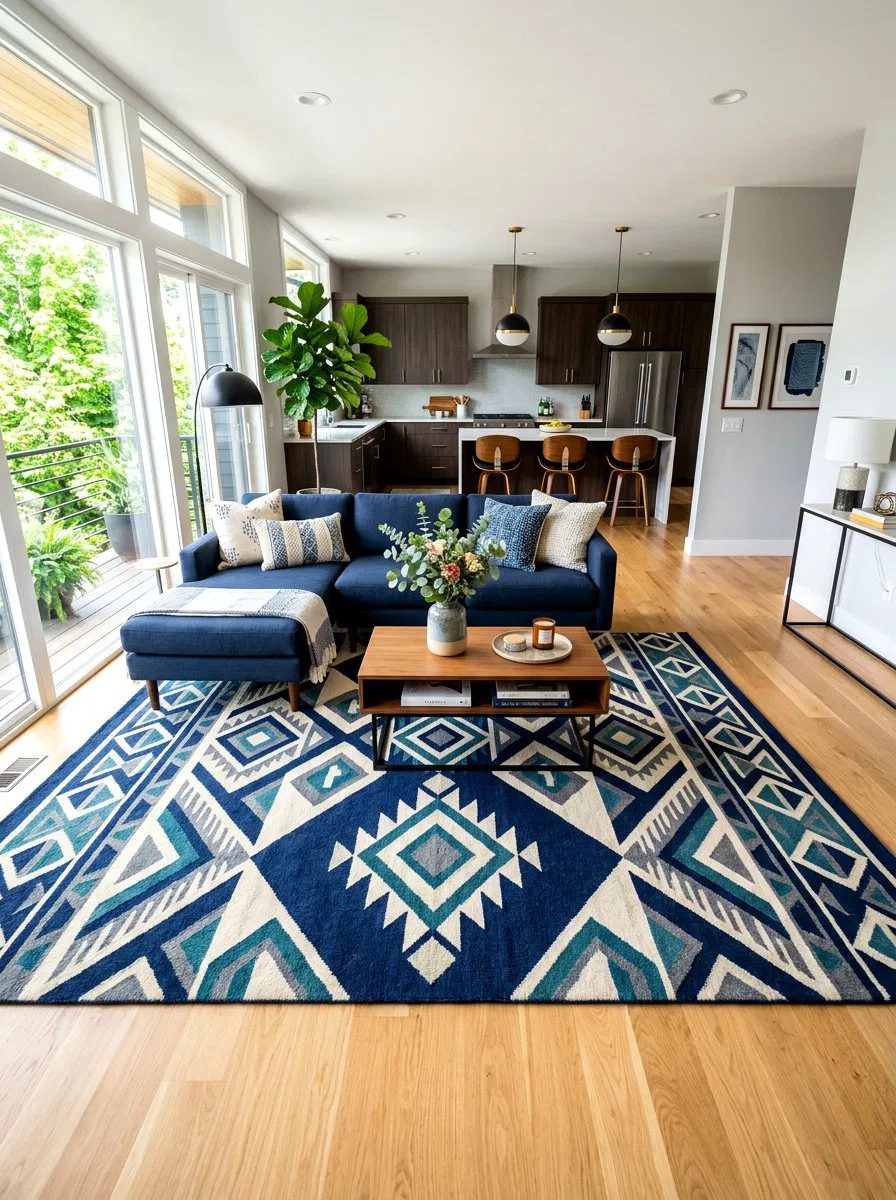
If you remember nothing else: the front legs of your sofa and chairs belong on the rug — not floating beside it, not perched on the edge, but planted on it. This one decision does more than color or pattern, stitching separate pieces into one zone.
Front legs on and back legs off gives you the best of both worlds: anchored furniture without paying for a rug the size of a tennis court. All four legs on looks luxurious in large rooms — a bonus, not a requirement.
Size the rug to your seating, not your walls
Instead, measure your seating footprint — the rectangle of your sofa, chairs, and coffee table in conversation distance. Your rug must cover that rectangle, plus a margin.
- Loveseat plus one chair (rooms around ten by twelve or smaller): five-by-eight usually does it. Center it under the coffee table, loveseat's front legs on.
- Three-seat sofa, two chairs, coffee table (the classic twelve-by-fifteen): eight-by-ten is the sweet spot, leaving six to eight inches of rug beyond each side of the coffee table.
- Sectional or full seating group in a larger room: nine-by-twelve — the size where every front leg, and often every leg, lands on fabric.
Between sizes? Size up. A rug that's slightly generous always looks intentional; one that's slightly small always looks like a mistake.
The painter's-tape trick
Before you spend a dollar, outline your candidate size on the floor with painter's tape — a five-by-eight rectangle takes two minutes — then live with it for a day.
Walk around it. Set your coffee table inside the lines and confirm it clears the tape by a few inches on every side. Open every door that swings over the area. Sit on the sofa — does the taped frame hold your seating zone the way you pictured? This twenty-minute rehearsal catches nearly every sizing regret, and the tape peels up without a trace.
Mind your pile height and door clearance
A thick, plush rug feels wonderful underfoot and terrible under a swinging door. Before you fall for a high-pile style, check the gap beneath any door opening over the rug — most interior doors clear about three-quarters of an inch, and a rug pad shrinks that further.
Choose low-pile or flatweave where doors swing, and save deep piles for the seating zone. The same goes for low-clearance furniture — check the space under your sofa's base before assuming a thick rug-plus-pad stack will slide underneath.
Don't skip the rug pad
A rug pad is the least glamorous and most valuable part of this guide: it stops sliding and bunching, adds cushion, protects hardwood, and helps the rug last longer.
On hard floors, choose felt-and-rubber: felt for cushion, rubber for grip. On carpet, go thin and rubber-only so the stack doesn't buckle. Trim the pad an inch smaller than the rug on all sides so it never peeks out — and count its thickness in your door-clearance math.
Layering: the fix for a rug you love that's too small
Sometimes the rug you adore only comes too small. Layering solves it: lay a large, flat, neutral base rug — natural fiber weaves are the classic choice — and center the smaller patterned rug on top.
Three rules keep it deliberate. First, the base rug stays flat and quiet — it's the frame, not the art. Second, leave at least a foot of base visible on every side. Third, center both on the same axis as the coffee table so the stack reads as one composition. Done right, layering adds texture no single rug can match.
Frequently Asked Questions
Do all four legs of the sofa need to be on the rug?
No — front legs on is the rule that matters. All four legs on looks wonderful with nine-by-twelve rugs in big rooms, but front legs on delivers nearly all of the effect.
Can a rug be too big?
Yes. If less than six inches of floor shows around the edges, the rug reads as wall-to-wall carpeting and the room feels smaller. Leave a visible border and the rug looks like a choice, not a cover-up.
My living room is tiny. Is five-by-eight still right?
In rooms around ten by twelve or smaller, five-by-eight with front legs on is the sweet spot. If even that crowds the space, a four-by-six under just the coffee table works — but pull seating in tight so nothing floats off the edge.
How much bare floor should show around the rug?
Aim for twelve to eighteen inches; eight is fine in tight spaces. Even borders matter more than the exact number — consistent margins are what make a rug look deliberately placed.
Jenna re-taped her floor, ordered the eight-by-ten, and sofa, chairs, and coffee table finally looked like one room. Measure your seating footprint, tape the outline, check the doors, remember the front-leg rule — and the rug you unroll will look like the one you pictured.
Our Top Picks
Havenwood Camden Neutral Wool Rug
A warm, low-key neutral with a subtle woven texture that plays well with almost any sofa color. The kind of rug you stop noticing, in the best way.
- Works with nearly any color scheme
- Flat weave is easy to vacuum
- Shows crumbs and pet hair more than a patterned rug
WashWell Machine-Washable Low-Pile Rug
A practical pick for homes with kids, dogs, or red-wine habits. When life happens, you roll it up and toss it in the wash.
- Machine washable for easy cleanup
- Low pile clears most doors
- Feels thinner than a traditional rug without a pad underneath
Gorilla Grip Felt and Rubber Rug Pad
The unsung hero under your rug. It adds cushion, stops sliding and bunching, and protects hardwood floors from scratches.
- Keeps rugs from sliding or bunching
- Adds noticeable cushion underfoot
- Trimming it to size takes sharp scissors and some patience
ScotchBlue Original Multi-Surface Painter's Tape
Your rug-sizing secret weapon. Tape the outline on your floor, live with it for a day, and buy with confidence.
- Peels off cleanly with no residue
- Cheap enough to re-tape as many times as you want
- One roll runs out fast on large outlines