Priya bought her 65-inch TV first and figured out the stand later. For two years, the television has sat on a low open shelf she scored at a flea market, and the shelf has slowly become a museum of everything she owns: two remotes, three game controllers, a tangle of HDMI cables, a dusty router blinking behind a stack of DVDs, and a basket of spare batteries that never quite makes it back into the basket.
Last month her toddler started grabbing the controllers, and the router's blinking lights became irresistible. That is when she realized the problem was not her willpower — it was the furniture. Open shelving works in styled photos; in a real living room, it is a dust trap and a toddler magnet. She needed closed storage.
If your living room looks anything like Priya's, this guide is for you. Here is the practical advice that actually matters when you shop for a TV stand with hidden storage.
Size the Stand to Your TV, Not the Wall
The golden rule is simple: your stand should be wider than your TV, ideally by 6 to 12 inches total. A 55-inch TV is about 48 inches wide without its feet, so a 58 to 60-inch console looks balanced; a 65-inch TV wants a 66 to 72-inch console. A narrower stand looks top-heavy and tips more easily when bumped.
Check the weight limit too. Most 65-inch TVs weigh under 60 pounds, but consoles get loaded with speakers, receivers, and game systems — add up everything that will sit on top and inside, and make sure the capacity covers it comfortably.
Closed Storage vs. Open Shelving
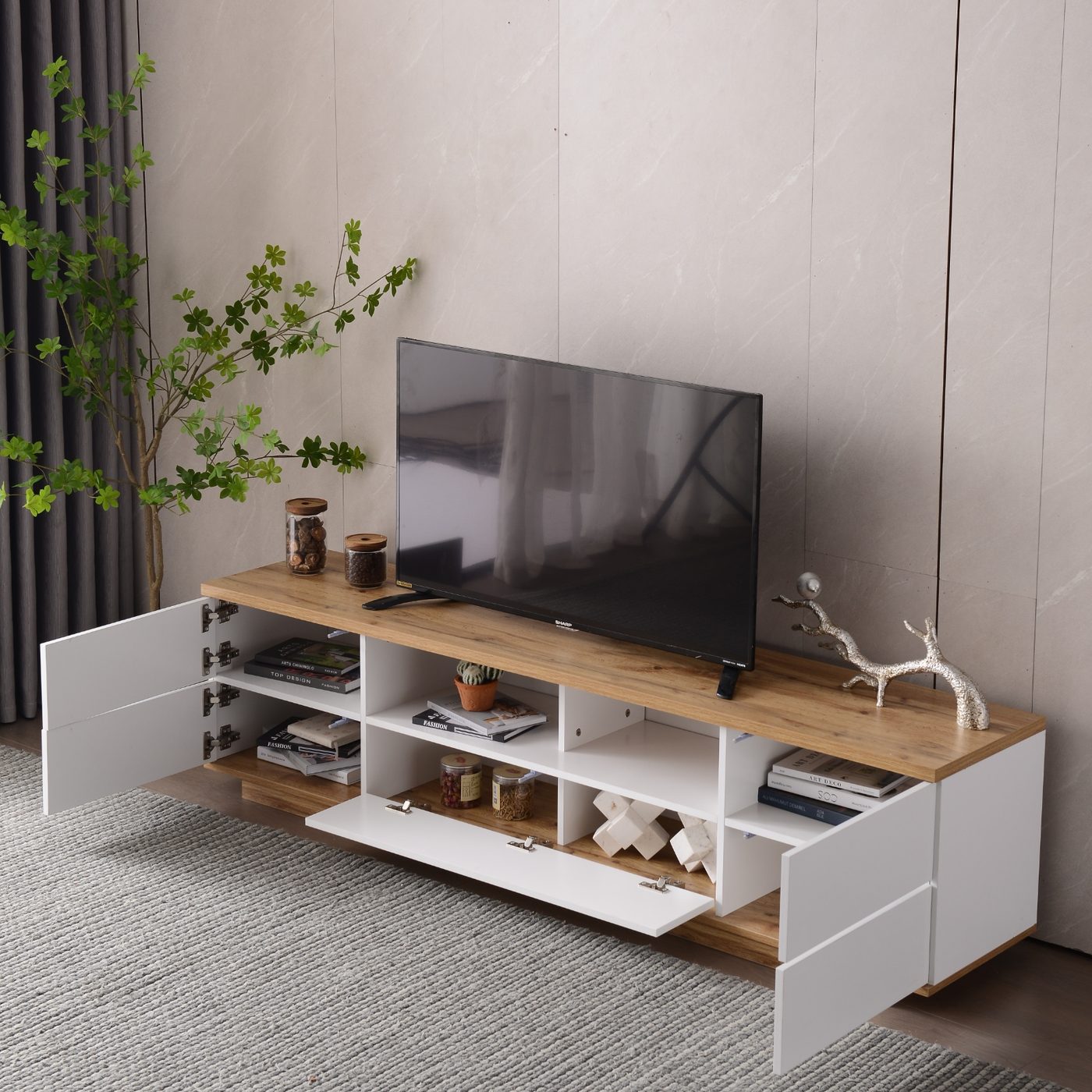
Closed storage — doors, drawers, flip-down panels — is the hero here, and for good reason:
- Dust stays out. Electronics collect dust fast, and dust means heat. Doors cut the cleaning in half.
- Clutter disappears. Controllers, cables, batteries, and discs live behind a panel instead of on a shelf.
- Kid and pet friendly. Doors keep curious hands and teeth away from blinking lights and chewable cables.
Keep one open section, though. A single open bay is the perfect home for a soundbar, which performs better and answers its remote more reliably when it is not sealed behind wood.
Cable Management That Actually Works
Before you fall in love with a design, look at the back panel. A good TV stand has pre-cut holes or grommets so cables can pass between shelves without drilling, and enough depth — around 16 to 18 inches — to fit a power strip and a coiled HDMI cable behind the devices. A hollow or open-backed section where a surge protector can live out of sight but stay reachable is a bonus.
During setup, bundle cables with reusable ties, label the power strip with a piece of tape, and route the router's cables through the nearest cutout so nothing dangles. Ten minutes of this saves years of cable spaghetti.
Ventilation: Don't Cook Your Console
Game consoles, receivers, and cable boxes generate real heat, and a closed cabinet traps it. Look for stands with ventilation cutouts or slatted back panels in the device bays — many hide these vents in the back so the front stays clean. Give any warm device about 2 inches of clearance above it, and never stack two of them together.
Routers run warm and their Wi-Fi weakens behind dense wood or metal, so the router earns a spot near a vent or in the open bay. During long gaming sessions, crack the cabinet door open.
Viewing Height and Seating Distance
The center of your TV screen should sit roughly at eye level when you are seated — usually 42 to 48 inches from the floor for a typical couch. Most TV stands are 20 to 28 inches tall, which puts a 55 to 65-inch TV right in that zone.
For distance, a practical guideline is 1.5 to 2.5 times the screen's diagonal. On a 65-inch TV, that means sitting roughly 8 to 13 feet away — which is conveniently how far most sofas sit from the media wall in a standard 12 by 15-foot living room.
Anchor It: The Safety Step Everyone Skips
A loaded stand with a big screen on top is a tipping risk, especially with toddlers who climb or dogs that bump into things. Every stand should come with anti-tip hardware — a strap or bracket that ties the furniture to a wall stud. Install it. It takes fifteen minutes and a drill, and heavier items belong on the bottom shelves.
Frequently Asked Questions
Should the TV stand be wider than the TV? Yes. Aim for a stand at least 6 to 12 inches wider than the television. This looks proportional, gives the TV's feet full support, and makes the whole setup more stable.
Can I put a game console inside a closed cabinet? You can, but it needs airflow. Choose a cabinet with ventilation cutouts, leave a couple of inches of clearance around it, and crack the door open during long sessions.
Will my router's Wi-Fi work inside a TV stand? It works best with breathing room. Solid wood doors slow the signal a little; metal doors slow it a lot. Put the router in an open bay or near a vent cutout.
How do I hide cables behind a TV stand? Use the back-panel cutouts to route cables between shelves, mount a power strip inside the cabinet, and bundle everything with reusable ties. A 16 to 18-inch-deep stand gives you room to coil excess cable out of sight.
The right TV stand will not organize your life, but it will make the living room look organized with far less effort. Measure your wall, size the stand to your screen, give your devices room to breathe, and bolt the whole thing to the wall. Priya did all four, and her weekends are dust-free now.
Our Top Picks
Harper 60-Inch Mid-Century TV Console with Doors
A warm-wood console with two wide cabinet doors that hides a game console, router, and a basket of remotes without looking like a storage unit.
- Closed cabinets keep dust off electronics
- Cord cutouts in the back panel for cable routing
- Solid doors mean the router signal may drop slightly
Norwich White Sliding-Door TV Stand
A budget-friendly stand with sliding doors that work well against a tight wall — no swing clearance needed in narrow living rooms.
- Sliding doors suit small walkways
- Open middle shelf keeps a soundbar within remote range
- Sliding doors only reveal half the cabinet at a time
Alder Creek Farmhouse TV Stand with Drawers
A mid-priced farmhouse-style stand with deep drawers that swallow board games, chargers, and spare batteries.
- Deep drawers handle bulky items like headsets
- Includes anti-tip hardware in the box
- Distressed finish can show scuffs on the tabletop
Lennox Low-Profile Media Console with Lift Top
A premium low console whose top panel lifts for hidden compartments — a sleek pick for minimal living rooms where nothing sits out.
- Hidden top compartments keep remotes truly out of sight
- Low profile keeps sightlines clean in small rooms
- Premium price for the lift mechanism
Bristol Rattan-Door TV Console
A mid-priced console with woven rattan doors that hide components while letting remote signals through. Warm texture softens a tech-heavy wall.
- Remote signals pass through rattan doors
- Hides cables and consoles completely
- Interior shelves are not adjustable
Moda Electric Fireplace TV Stand
A TV stand with a built-in electric fireplace insert and closed storage on both sides. Adds ambiance and hides everything in one piece.
- Fireplace adds cozy ambiance without venting
- Ample closed storage for media gear
- Heavier power draw; needs a dedicated outlet nearby