Dave's garage had a name in the neighborhood: the Bermuda Triangle. Lawnmowers went in and didn't come out. He'd bought a second set of hedge trimmers because he couldn't find the first. His car hadn't seen the inside of the garage in four years — it lived in the driveway, collecting sap, while $400 worth of "storage solutions" (three wobbly plastic shelf units and a pile of mismatched totes) sagged against the wall.
Garages fail differently than closets. They hold heavy, dirty, oddly shaped things. They swing between freezing and sweltering. And they're the only room where the goal isn't just tidiness — it's reclaiming hundreds of square feet you already own. The systems below are the ones that survive contact with real garages: heavy loads, daily use, and the occasional dropped toolbox.
Start with Zones, Not Products
Before buying anything, divide the garage into zones on paper:
- Daily grab zone near the house door: shoes, bags, sports gear kids use constantly.
- Tool zone along one wall: hand tools, power tools, workbench if you have one.
- Bulk storage zone: seasonal bins, holiday decor, camping gear — things you touch a few times a year.
- Car zone: the actual parking space. Measure it and defend it like territory.
Everything you buy should serve a zone. Random shelves without zones just become expensive clutter holders.
The Walls Are Your Best Real Estate
Floor space in a garage is precious — it's where cars, workbenches, and walking happen. The walls are free. Slatwall panels like the Gladiator system turn a bare wall into a reconfigurable grid: hang bikes, ladders, extension cords, and yard tools on locking hooks, then rearrange in minutes when your needs change. Metal pegboard does the same for hand tools at a lower price, with the huge advantage that you can see everything at once — no more buying a third tape measure.
Mount into studs, not drywall. Garage walls take real weight, and a loaded panel pulling out of drywall is a miserable repair. A $20 stud finder is the cheapest tool in this entire project.
Go Up: The Ceiling Is Wasted Space
The air above your car is the biggest unused storage volume in most homes. Overhead ceiling racks lift seasonal totes, luggage, and camping gear into space that was doing nothing. They're rated for hundreds of pounds and, once installed, the only effort is a twice-yearly rotation.
Bike hoists do the same trick for bicycles — a rope-and-pulley system that lifts a bike flat against the ceiling. Each hoisted bike frees roughly 12 square feet of floor. For a two-bike household, that's a parking space's worth of room back.
Contain the Small Stuff
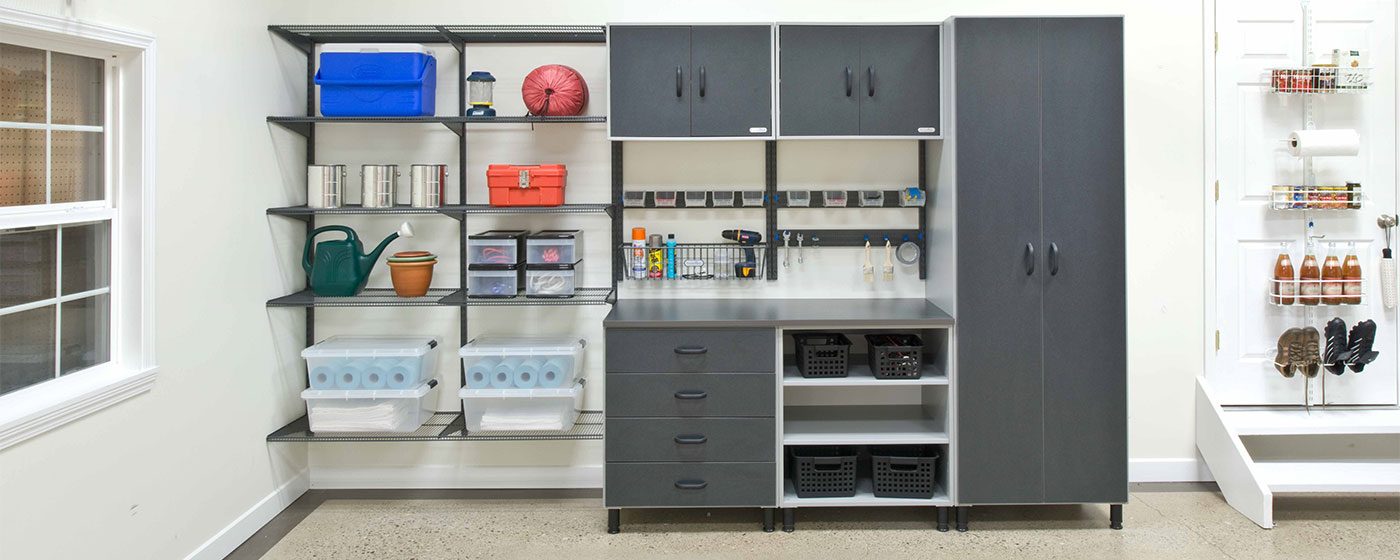
Garages eat small items: screws, batteries, tape, sandpaper, that one specific Allen key. The fix is boring and effective — clear stackable bins on heavy-duty shelving, labeled by category. One shelf for "fasteners," one for "tape and adhesives," one for "electrical." When every small thing has a labeled home, the workbench stops being a junk pile.
For chemicals — paint, pesticides, automotive fluids — keep them on a dedicated shelf, off the floor, away from the water heater and furnace. Locked if kids are around. This is a safety rule, not an organizing tip.
Frequently Asked Questions
How much does it cost to organize a garage properly? A solid basic setup — one slatwall section, one heavy shelving unit, and a dozen bins — runs $300 to $600. Overhead racks add $100 to $200 each. It's the highest square-footage-per-dollar organizing project in the house.
Can I do this in a rental? Freestanding shelving, yes. Anything screwed into walls or ceiling, ask first — or stick to freestanding units and rolling carts you can take with you.
How do I keep it organized after the big push? The zone system does the heavy lifting: everything has a home, so put-away takes seconds. Do a 20-minute seasonal reset (spring and fall) to rotate gear and purge what's broken.
What about extreme temperatures? Don't store paint, batteries, or aerosols where they'll freeze or bake — temperature swings ruin them. Electronics and photographs belong inside the house, not the garage.
The Bottom Line
An organized garage isn't about perfection — it's about getting your floor back. Zones first, walls second, ceiling third, and labeled bins for everything small. Do it once, do it right, and park your car inside this winter.
Our Top Picks
Gladiator GearWall Slatwall Panels (2-Pack)
Heavy-duty wall panels with locking hooks that hold bikes, tools, and ladders. Reconfigurable without new holes.
- Hooks lock in — nothing slides off
- Holds up to 75 lbs per square foot
- Panels themselves need solid stud mounting
Fleximounts Overhead Garage Storage Rack
A ceiling-mounted steel rack that lifts seasonal bins and luggage off the floor into dead airspace.
- Frees up to 100+ cubic feet of floor space
- Height adjustable after install
- Two-person installation job
DeWalt 4-Tier Heavy-Duty Metal Shelving
A 72-inch steel shelf unit rated for thousands of pounds total. The backbone of any serious garage.
- Assembles without tools in minutes
- Each shelf holds 2,500 lbs
- Deep shelves can hide small items
Wall Control Metal Pegboard Tool Organizer
Steel pegboard panels with locking hooks for hand tools. Everything visible, everything in reach, nothing in a pile.
- Hooks lock so tools stay put
- Magnetic accessories add flexibility
- Panel layout takes planning to get right
RAD Cycle Bike Hoist (2-Pack)
Pulley hoists that lift bikes flat to the ceiling with a rope pull. Frees a full bike's worth of floor space each.
- One person can hoist a bike easily
- Rubber-coated hooks protect frames
- Needs ceiling joists, not drywall