Tom started working from home with a laptop on his kitchen table. That lasted three weeks, until his back, his neck, and his roommate's lunch schedule all filed complaints. He moved to the bedroom, where the only option was a wobbly card table shoved against the wall. His monitor sat too low, his knees hit the crossbar, and the whole setup screamed "temporary," even after eight months.
The problem was not Tom's bedroom. Plenty of people work productively from a corner of a bedroom. The problem was the desk: too deep for the space, too unstable for daily use, and designed for poker night, not eight-hour workdays.
A good small-space desk does three things: it fits your room, it fits your body, and it disappears visually when you are done working. Here is how to find one.
Depth Matters More Than Width
Everyone measures width. Almost nobody measures depth, and depth is what determines whether a desk works in a small room. A standard desk is 28 to 30 inches deep. In a tight space, 20 to 24 inches is often plenty for a laptop or a single monitor on an arm.
Shallower desks also force better ergonomics. With 20 inches of depth, your monitor naturally sits at a reasonable distance. With 30 inches, people push the monitor to the back and crane forward, which is how neck pain starts.
Measure your space with tape on the floor, then subtract 30 inches for your chair. What is left is your maximum desk depth. Shop to that number, not to the width.
Desk Types That Actually Work in Small Spaces
Writing desks are the simplest answer. A 40-inch writing desk with a steel frame holds a monitor, keyboard, and notebook, costs less than most "office desks," and looks fine in a bedroom. The trade-off is zero storage, so pair it with a small drawer unit or wall shelves.
Wall-mounted fold-down desks are ideal when the room has another job. Folded down, they are a full workstation. Folded up, the room is a bedroom again.
Standing desk converters solve the problem differently: they turn furniture you already own into a workstation. A converter on a dining table or sturdy console gives you sit-stand flexibility without buying a full standing desk. They do eat into your surface area, so they work best on tables 48 inches or wider.
Corner desks reclaim the most wasted space in a room. A compact L-shape tucks into a corner and gives you two work zones, one for the monitor and one for writing or a laptop. Measure both walls of the corner before buying.
The Stability Test
A desk that wobbles will ruin your workday in ways you do not notice until your shoulders ache. Before buying, check the frame design: X-bracing, a solid back crossbar, or a heavy steel frame all prevent wobble. Read reviews specifically for the word "wobble" or "shaky." Lightweight desks under 25 pounds almost always need wall anchoring or bracing to feel solid with a monitor on top.
If you already own a wobbly desk, try tightening every bolt, adding adhesive furniture pads under the feet, or anchoring it to the wall with a ten-dollar anti-tip strap before replacing it.
Cable Management: The Part Everyone Skips
A small desk looks twice as cluttered with visible cables. Plan for three things: a cable tray or basket under the desk, a short power strip mounted to the desk underside, and cable clips to route the monitor and charger cords. This costs about twenty dollars and takes thirty minutes, and it is the difference between a workspace that feels calm and one that feels chaotic.
Run cables before you position the desk against the wall. It is ten times harder once the desk is in place.
Common Mistakes
The biggest mistake is buying a desk for your dream setup instead of your real one. A 60-inch gaming desk with RGB lighting does not belong in a 9-by-10 bedroom office corner. Buy for the room you have.
The second mistake is ignoring chair clearance. A desk that fits the wall but leaves 20 inches for your chair means you will sit sideways forever. You need at least 30 inches behind the desk for a chair, more if the chair has arms.
The third mistake is the glass top. Glass desks look airy in photos and show every cable, fingerprint, and coffee ring in real life. In a small space you see the desk constantly, so choose a surface that looks good messy.
Frequently Asked Questions
What is the best desk size for a small bedroom office? A 40 to 48 inch wide desk at 20 to 24 inches deep fits most bedroom corners while leaving room for a chair. Tape the footprint on the floor first.
Can I use a dining table as a home office desk? Yes. A dining table at 28 to 30 inches high works with most office chairs. Add a standing desk converter if you want height adjustability, and a cable tray to keep it tidy.
Are wall-mounted desks sturdy enough for a monitor? When mounted into studs, yes. Most support 30 to 50 pounds, which covers a monitor, laptop, and accessories. Avoid mounting only into drywall.
How do I hide my office in a bedroom after work? A fold-down wall desk is the cleanest solution. Otherwise, use a desk with a curtain panel, store work supplies in a lidded box, and choose a chair that looks like bedroom furniture.
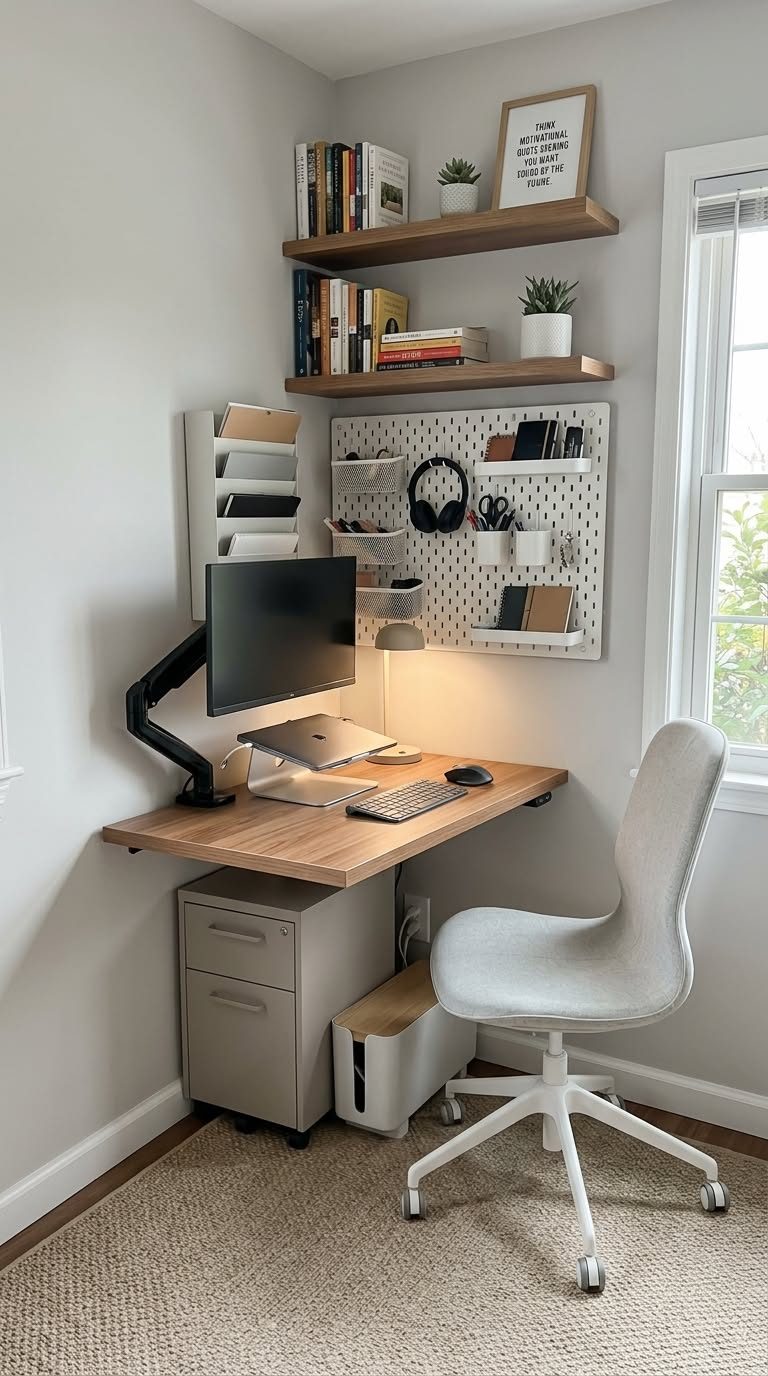
Tom ended up with a 42-inch writing desk, a monitor arm, and a cable tray, all in the corner where the card table used to wobble. His bedroom still looks like a bedroom. His workday finally feels like it happens at a desk instead of at a compromise. That is all a small-space desk needs to do: fit the room, hold steady, and let the rest of the space stay yours.
Our Top Picks
SlimLine 40-Inch Writing Desk
A simple 40-inch desk with a slim profile that fits a laptop, monitor, and notebook without swallowing a bedroom corner.
- Only 20 inches deep
- Sturdy steel frame, no wobble
- Clean look works in bedrooms
- No drawers or built-in storage
WallDesk Fold-Down Office Desk
A wall-mounted desk that folds flat when the workday ends, turning any wall into a part-time office.
- Folds completely flat to the wall
- Built-in shelf for supplies
- Frees floor space after hours
- Must mount into wall studs
RiseUp Standing Desk Converter
A sit-stand riser that sits on your existing desk or table, giving you a height-adjustable workstation without replacing furniture.
- No need to replace your desk
- Smooth gas-spring height adjustment
- Holds monitor and keyboard
- Reduces usable desk surface underneath
CornerFit L-Shaped Compact Desk
A compact L-shaped desk designed to tuck into a corner, giving you two work surfaces in the footprint of one.
- Uses dead corner space
- Room for monitor plus laptop
- Reversible for left or right corners
- Assembly takes about an hour
NestDesk Rolling Laptop Cart
A budget rolling cart with a height-adjustable top that works as a desk anywhere. Roll it to the couch, the balcony, or back to the corner.
- Works in any room, then rolls away
- Height adjusts for sitting or standing
- Small surface fits a laptop, not a full setup
HideAway Secretary Desk with Hutch
A premium secretary desk whose fold-down top closes to hide work clutter completely. When shut, it reads as a handsome cabinet.
- Closes to hide all work clutter
- Hutch cubbies organize supplies
- Premium price; heavy to move
FloatShelf Wall-Mounted Desk
A mid-priced floating desk that mounts to the wall with zero legs. Keeps floor space completely open underneath for a chair or storage.
- Zero floor footprint
- Sturdy when mounted to studs
- Must mount into studs; not renter-friendly without permission
LiftPro Electric Standing Desk 40-Inch
A premium 40-inch electric standing desk with memory presets. Compact enough for small rooms but with true sit-stand functionality.
- Quiet motor with memory presets
- Compact 40-inch top fits small spaces
- Needs a nearby outlet; cable management required