Every night at 10:30, the same negotiation plays out in Lena's apartment in Seattle. She wants one more chapter. Her husband wants sleep. The overhead light is a floodlight, her phone screen gives her a headache, and the old table lamp she grabbed from a thrift store throws a harsh glare across his pillow. "Just read in the living room," he mumbles into the pillow. She does not want to read in the living room. She wants to read in bed, like a person.
The fix was not a fancier lamp. It was the right lamp: warm, dimmable, and directional enough to light her book and nothing else. If you share a bed with someone on a different schedule — or you just want reading light that does not feel like an interrogation — here is what actually matters.
Brightness: Enough for Pages, Not for the Room
For reading, you want focused light around 400 to 800 lumens at the page — roughly a 40-to-60-watt old incandescent equivalent. More than that and you are lighting the whole bedroom; less and you will strain your eyes.
Dimmability matters more than maximum brightness. A lamp with three or more levels (or smooth touch dimming) lets you start bright and ease down as your eyes tire. Single-brightness lamps are the number one reason bedside lighting feels wrong.
Color Temperature: Stay Warm
Look for 2700K — the warm, amber-white of classic incandescent bulbs. It is relaxing, flattering, and least disruptive to sleep hormones. Anything labeled "daylight" (5000K+) belongs in a home office, not six inches from your pillow.
If you read on both paper and a tablet, consider a lamp with adjustable color temperature. Warmer for wind-down, slightly cooler when you need sharper contrast.
Directional Beats Diffuse for Shared Beds
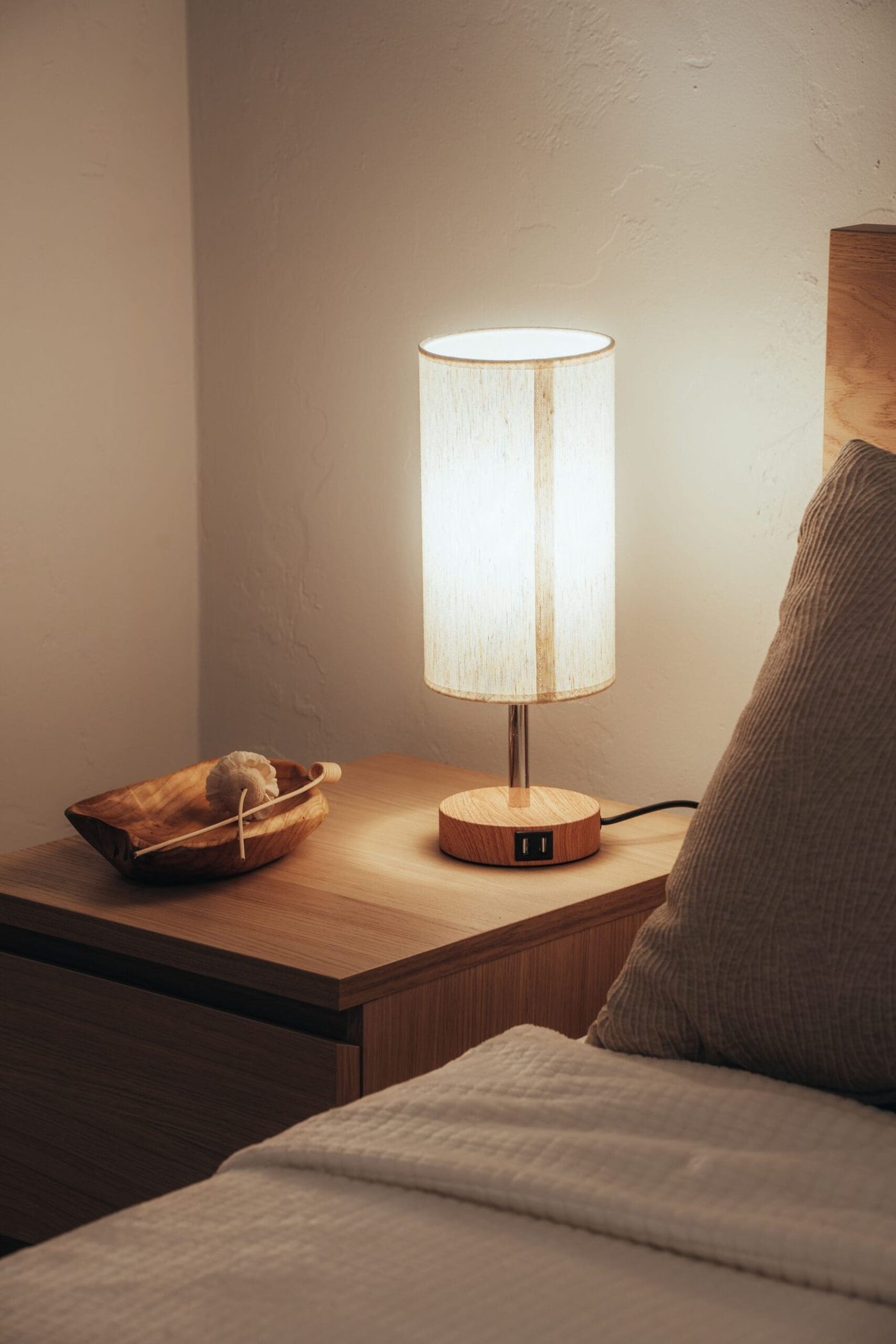
This is the key insight for couples: a fabric shade glows in all directions, including onto your partner's face. A directional lamp — gooseneck, adjustable head, or clip-on bar — puts light on your pages and keeps the rest of the bed dark.
That does not mean shaded lamps are bad. If you sleep alone or your partner sleeps through anything, a shaded lamp's soft ambient glow is lovely. But if your partner is light-sensitive, directionality is non-negotiable.
Size and Placement: The Two-Thirds Rules
Two quick rules that designers actually use:
- Height: The bottom of the shade should sit roughly at your shoulder level when you are sitting up in bed — usually a lamp 24 to 28 inches tall on a standard nightstand. Too short and the bulb glares in your eyes; too tall and it lights the ceiling.
- Scale: The lamp should be about one-third the width of the nightstand surface and no wider than the nightstand itself. A giant lamp on a tiny table looks absurd and leaves no room for your book, water, or phone.
Place the lamp on the side of your dominant reading hand to avoid casting a shadow across the page — right side for right-handed readers.
Features Worth Paying For (and Skipping)
Worth it: USB charging ports in the base (frees an outlet and kills cable clutter), touch dimming (no fumbling for a switch in the dark), and a weighted base (nothing worse than a lamp that topples when you reach for it half asleep).
Skip it: Built-in Bluetooth speakers (the sound quality is always disappointing), elaborate smart-home integration you will never program, and novelty shapes that look fun online but throw light in useless directions.
Common Mistakes
- Matching the overhead bulb temperature. Cool-white bedside bulbs next to warm room lighting feels jarring. Keep bedside light at 2700K.
- One lamp for two readers. If you both read, you both need a lamp. Sharing one central lamp means one of you reads in shadow.
- Ignoring the shade interior. White-lined shades reflect more usable light downward; dark-lined shades look moody but eat half your brightness.
- Placing the lamp behind you. Light should come from the side or slightly in front, never from directly behind your head — that is how you get page glare and neck shadows.
Frequently Asked Questions
What is the best bulb for a bedside reading lamp? A dimmable LED at 2700K, 40-to-60-watt equivalent. Dimmable matters — non-dimmable LEDs can flicker or buzz on dimmer circuits, so match the bulb to the lamp's dimming type.
Is reading in bed bad for your eyes? Reading itself is fine; poor light is the problem. Dim, uneven, or glaring light causes eye strain and headaches. A properly aimed warm lamp at adequate brightness is as easy on your eyes as daytime reading.
How do I keep my lamp from disturbing my partner? Use a directional lamp aimed at your pages, keep brightness at the lowest comfortable level, and choose 2700K warm light. A small clip-on book light is the nuclear option for truly light-sensitive partners.
Should bedside lamps match? They do not have to be identical, but they should relate — same height, similar warmth, complementary style. Wildly mismatched lamps make the bedroom feel accidental.
The perfect bedside reading lamp is not the most expensive one. It is the one that puts warm, adjustable light exactly on your pages and nowhere else — so you get your chapter, and your partner gets their sleep. Everybody wins.
Our Top Picks
PageLight Adjustable Gooseneck Table Lamp
A compact lamp with a flexible gooseneck that aims light exactly at your pages — and away from a sleeping partner.
- Directional head keeps light off your partner
- Three brightness levels with memory
- Small base can wobble on soft bedding
WarmGlow Fabric Shade Lamp with USB Ports
A classic fabric-shade lamp with two built-in USB ports in the base, so the nightstand stays free of charging bricks.
- Charges phone and watch overnight
- Soft diffused glow, easy on eyes
- Not dimmable — single brightness
ClipBeam Minimalist Bedside Reading Light
A slim clip-on bar that attaches to headboards or shelves for focused reading light in the tiniest of nightstand setups.
- Takes zero nightstand space
- Warm-to-cool adjustable color temperature
- Clip needs a firm edge to grip
DuoCharge Touch-Dimmable Lamp Set of 2
A matched pair of touch-dimmable lamps with a warm 2700K glow — an easy, affordable upgrade for both sides of the bed.
- Tap anywhere to dim through 3 levels
- Two lamps for the price most charge for one
- Touch sensor can trigger when dusting
HaloRing LED Bedside Lamp with Wireless Charger
A modern ring-shaped LED lamp with a wireless charging pad in the base. One bedside footprint handles both light and phone charging.
- Charges your phone while you sleep
- LED ring gives even, glare-free light
- Charging pad only works with compatible phones
BrassArc Pharmacy Table Lamp
A premium pharmacy-style lamp with an adjustable arm and brass finish. Directs a focused pool of light exactly onto your book.
- Adjustable arm aims light precisely
- Brass finish looks high-end
- Premium price for a single-purpose lamp
MoonBeam Amber Night Light Lamp
A tiny budget lamp with a warm amber glow for middle-of-the-night wakeups. Dim enough not to wake a partner, bright enough to find the hallway.
- Amber light is easy on sleepy eyes
- Costs less than a takeout coffee
- Too dim for actual reading