Marcus ate dinner on his couch for fourteen months. It was not a lifestyle choice. His studio apartment had a corner he called "the dining area," which was really just the three feet between the kitchen counter and the bookshelf, and every table he looked at seemed built for a suburban dining room. The round ones were too wide, the rectangular ones blocked the walkway, and the cheap folding ones wobbled so badly his coffee migrated across the table on its own.
Then a friend with an even smaller apartment showed him her setup: a drop-leaf table against the wall that seated two on weeknights and opened up for six at Thanksgiving. Marcus measured his corner that evening. He had forty-two inches of wall and thirty inches of walkway to spare. Within the week he had a table, two chairs, and the novel experience of eating at an actual table.
Choosing a dining table for a small space is mostly a measuring exercise with a little bit of shape strategy. Get the measurements right and almost any style works. Get them wrong and even a beautiful table becomes an obstacle you resent.
Measure First: The Numbers That Matter
You need three measurements: the space for the table itself, clearance around it, and the walkway behind the chairs.
- Per-person width: Allow 24 inches of table edge per diner. A 36-inch round table seats four. A 48-inch table seats six.
- Chair clearance: Leave at least 36 inches from the table edge to the wall or furniture behind it, so someone can pull out a chair and sit down. In a tight squeeze, 30 inches works if diners can slide in from the side.
- Walkway: If people need to walk past the table while others are seated, you need 44 inches minimum from table edge to the opposite wall.
Measure your actual space with painter's tape on the floor before shopping. Tape out the table footprint and live with it for a day. Walk around it. Sit in the imaginary chairs. This ten-minute exercise prevents more bad purchases than any review.
Shapes That Work in Small Spaces
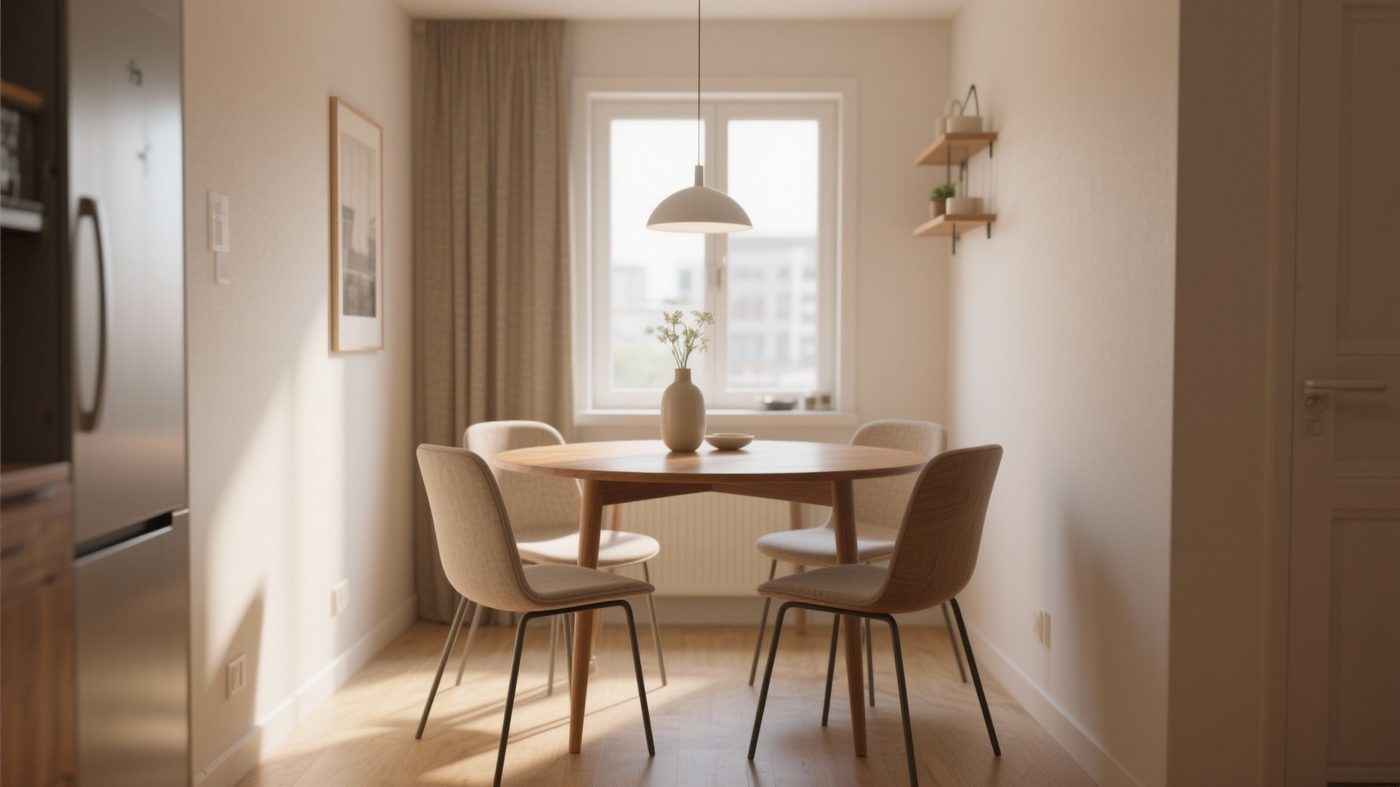
Round tables are the small-space classic for a reason. A 36-inch round seats four with no sharp corners jutting into walkways, and a pedestal base means nobody fights table legs for foot room. The trade-off is that round tables do not push against walls efficiently.
Drop-leaf tables are the most flexible option. With leaves down, a drop-leaf is a slim console against the wall. With leaves up, it seats four to six. If your dining area doubles as a walkway or workspace, this is usually the right answer.
Rectangular tables work best pushed against a wall or in a narrow eat-in kitchen, where their shape matches the room. Look for ones with the extension leaf stored inside the table so you are not storing a loose panel in a closet.
Wall-mounted fold-down tables are the nuclear option for studios. Folded flat, they disappear. Opened, they seat two to four. They require solid wall mounting into studs, so renters should check with their landlord first.
Materials and Maintenance
For daily use, prioritize wipeable surfaces. Solid wood looks warm and can be refinished, but it needs coasters and quick wipe-ups. Wood-look laminate and sealed surfaces forgive red wine and hot mugs. Glass makes a small room feel bigger but shows every fingerprint. If you have kids or host messy dinners, choose the surface you can wipe down without thinking about it.
Check the base as much as the top. Pedestal bases free up legroom but can feel tippy on very large tops. Four-leg tables are sturdier but the legs dictate where chairs can go. Sit at the table, or imagine sitting at it, and check that your knees clear any apron or support bar.
Common Mistakes to Avoid
The biggest mistake is buying for the dinner party instead of the Tuesday. If you host six people twice a year but eat as two every night, buy the table that works for two and expands, not the six-seater that crowds your room 363 days a year.
The second mistake is forgetting chair storage. Four dining chairs take up real space when guests leave. Stackable chairs, folding chairs, or a bench that tucks fully under the table solve this.
The third mistake is the wobble. Cheap lightweight tables shift every time someone leans on them. Check the weight rating and look for cross-bracing or a solid pedestal. A table that moves when you cut food will annoy you daily.
Frequently Asked Questions
What size dining table fits in a small apartment? For most small apartments, a 36-inch round or a 36-by-48-inch rectangular table is the sweet spot, seating four without dominating the room. Tape the footprint on your floor before buying.
Is a round or rectangular table better for small spaces? Round tables improve traffic flow and eliminate corner collisions, making them better for open areas. Rectangular tables use wall space more efficiently, making them better for narrow eat-in kitchens.
Can I use a dining table as a desk in a small apartment? Absolutely, and many people do. Choose a table height of 28 to 30 inches, which works for both dining chairs and most desk chairs, and pick a wipeable surface that handles laptops and coffee equally well.
How much should I spend on a small dining table? A solid, wobble-free small table typically runs 150 to 400 dollars. Below that range, check stability carefully. Above it, you are paying for materials and design rather than function.
Marcus still has a studio. The walkway is still thirty inches wide. But he eats at a table now, and when his sister visits, the leaves go up and there is room for her too. The right small-space table is not the smallest one you can find. It is the one that fits your actual room, your actual Tuesday nights, and the occasional Thanksgiving.
Our Top Picks
FoldAway Drop-Leaf Dining Table
A compact table with hinged leaves that seats two daily and expands to seat six when guests come over.
- Seats 2 daily, expands to 6
- Slim profile when leaves are down
- Solid wood-look top wipes clean
- Leaf hinges need occasional tightening
RoundUp 36-Inch Pedestal Table
A 36-inch round table on a single pedestal base, the classic small-space shape with no corner legs to bump into.
- No legs to fight for foot room
- Fits four comfortably
- Round shape improves traffic flow
- Center pedestal limits legroom for a fifth chair
ExtendRight Compact Dining Table
A rectangular table with a hidden extension leaf stored inside, stretching from weeknight size to dinner-party size.
- Extension leaf stores inside the table
- Seats 4 to 8 depending on setup
- Clean modern lines
- Heavier than it looks when extended
WallMount Fold-Down Table
A wall-mounted table that folds flat against the wall when not in use, ideal for studios and eat-in kitchens.
- Folds completely flat to the wall
- Doubles as a desk or entry table
- Frees floor space daily
- Requires secure wall mounting into studs