When Jenna moved into her one-bedroom in Chicago, the first thing she did was paint an accent wall a warm terracotta. The second thing she did was stare at it, completely blank, for three weeks. She had spent her budget on the couch and the rug, and the idea of filling a twelve-foot wall with art felt financially impossible. Every framed print she liked online cost more than her monthly grocery bill.
That stuck feeling is familiar to almost anyone decorating on a real budget. Bare walls make even a nice room feel temporary, like you are still waiting for your actual life to start. But the difference between walls that look empty and walls that look intentional rarely comes down to money. It comes down to scale, framing, and having a point of view.
The secret designers know is that cheap art looks cheap mostly because of presentation, not the image itself. A ten-dollar print in a good frame, hung at the right height and in the right grouping, will outperform a two-hundred-dollar print that is too small and hung too high. Here are ten approaches that prove it.
1. Go oversized with a single canvas
One large piece beats five small ones on a big wall. A single 36-by-48-inch canvas over a sofa fills the visual space that a cluster of small frames never quite manages. Look for abstract prints in muted tones — they are forgiving, they match everything, and at large scale they read as confident rather than decorative.
2. Frame engineering prints
Architectural print shops will print your files at 24 by 36 inches for a few dollars on thin bond paper. Upload a high-resolution landscape photo, a vintage map, or even a typographic quote you designed. Then put it in a proper frame. The paper is thin, but behind glass nobody can tell.
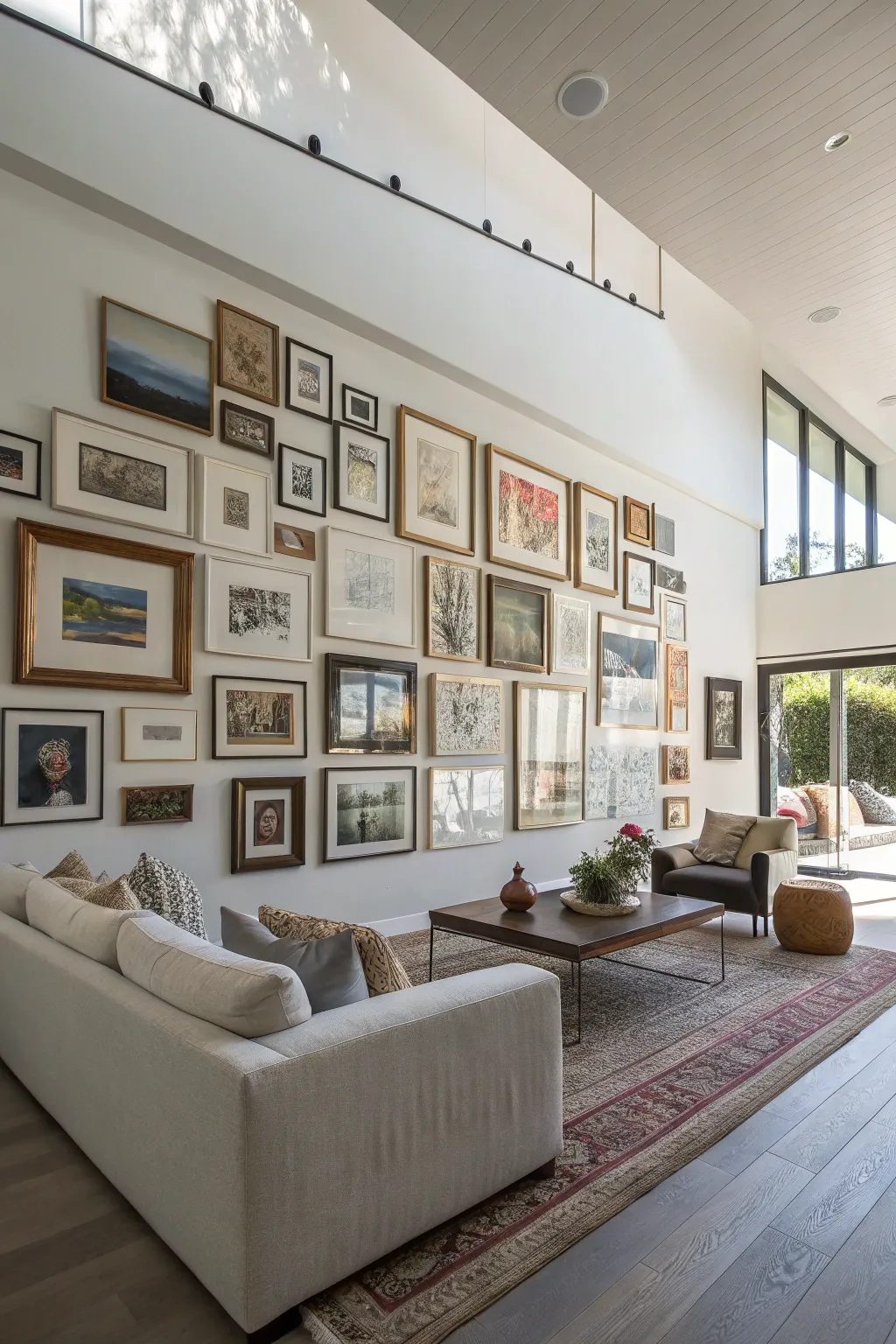
3. Build a thrifted frame gallery wall
Thrift stores are full of solid wood frames for a few dollars each. Buy an assortment, spray-paint them all the same color — matte black or warm brass — and suddenly mismatched frames look like a curated collection. Fill them with pages from art books, postcards, or your own photography.
4. Hang a textile
A flat-weave rug, a vintage scarf, or a length of interesting fabric hung from a simple wooden dowel adds warmth and texture that framed paper cannot. Textiles also solve the sound problem in echoey apartments, softening rooms with hard floors.
5. Try a leaning arrangement
Not everything needs a nail. Leaning two or three framed prints on a console table or mantel creates a relaxed, layered look, and it is completely renter-friendly. Vary the heights and overlap the frames slightly for a collected feel.
6. Print your own photography large
That photo you took on a trip — the foggy coastline, the desert road — probably deserves better than your phone screen. Print it at 18 by 24 inches or larger at a local print shop. Personal photography is the one art nobody else has, and large prints of your own memories never look generic.
7. Use floating shelves as art ledges
A single picture ledge shelf lets you layer framed prints, small canvases, and objects without committing to nail holes. You can rearrange the composition in minutes, which makes it perfect for people whose taste changes seasonally.
8. Frame pages from books
Coffee-table books on art, photography, and design are essentially portfolios of ready-made prints. Carefully remove pages you love and frame them. A twenty-dollar used book can yield a dozen frameable images.
9. Add a mirror as art
A well-placed mirror is wall art that also bounces light around the room. Round mirrors soften rooms full of rectangles, and an arched mirror adds architecture to a plain rental wall. Hang it where it reflects something worth looking at — a window, not a blank ceiling.
10. Create a salon wall slowly
The most convincing gallery walls are not bought in a weekend. Start with three pieces you genuinely like, hang them, and add one piece every few months. Walls that grow over time look collected. Walls bought all at once look decorated.
Common mistakes to avoid
- Hanging art too high. The center of a piece should sit around 57 inches from the floor — roughly eye level. Above a sofa, leave six to eight inches between the top of the sofa and the bottom of the frame.
- Choosing pieces that are too small. Art that is less than two-thirds the width of the furniture beneath it looks lost. When in doubt, go bigger.
- Matching everything. A gallery wall where every frame and print coordinates perfectly looks like a hotel. A little tension — different sizes, one unexpected piece — is what makes it feel personal.
Frequently Asked Questions
How much should I budget for a gallery wall? For a wall above a standard sofa, plan on 60 to 150 dollars total if you thrift frames and print your own images. The frames are the investment; the art inside them can cost almost nothing.
Can I hang art in a rental without losing my deposit? Yes. Adhesive picture-hanging strips hold surprising weight and remove cleanly, and leaning art on furniture requires no holes at all. Many landlords also accept small nail holes as normal wear, but check your lease.
What size art goes over a queen bed? Aim for a piece or grouping that spans about two-thirds the width of the bed — roughly 40 to 48 inches for a queen. One oversized piece is simpler and usually more striking than several small ones.
Where can I find free high-resolution images to print? Museum websites often offer public-domain artwork downloads at print quality, and several libraries have digitized vintage map and botanical collections. Always check the usage rights before printing.
A finished wall does not require a finished budget. Start with one piece you love, frame it well, hang it at the right height, and let the wall grow from there. The rooms that feel most like home are rarely the ones that were decorated the fastest.
Our Top Picks
Studio McGee Threshold Oversized Abstract Canvas
A large-scale abstract canvas with soft, muted brushstrokes that reads far more expensive than it is. The gallery-wrapped edge means no frame is required.
- Oversized scale fills a blank wall on its own
- Neutral palette works with most sofa colors
- Heavier than expected — needs a proper wall anchor
IKEA RIBBA 24x36 Picture Frame
The workhorse of budget gallery walls. The deep profile and clean lines make even a simple print look deliberate, and the front plastic keeps it light.
- Deep frame profile looks custom at a glance
- Light enough to hang with simple hooks
- Plastic front can glare under direct light
Artland Gallery-Wrap Floating Frame Set
A set of thin floating frames that instantly upgrades stretched canvases or canvas prints. They add a finished edge that cheap canvas art usually lacks.
- Makes unframed canvas look gallery-finished
- Slim profile keeps the focus on the art
- Sizing must match your canvas exactly
Command Large Picture Hanging Strips
Not art itself, but the reason renters can have a gallery wall at all. They hold real weight and come off cleanly when your lease ends.
- No holes — fully renter-friendly
- Holds frames up to 16 pounds per set
- Textured walls can reduce adhesion